
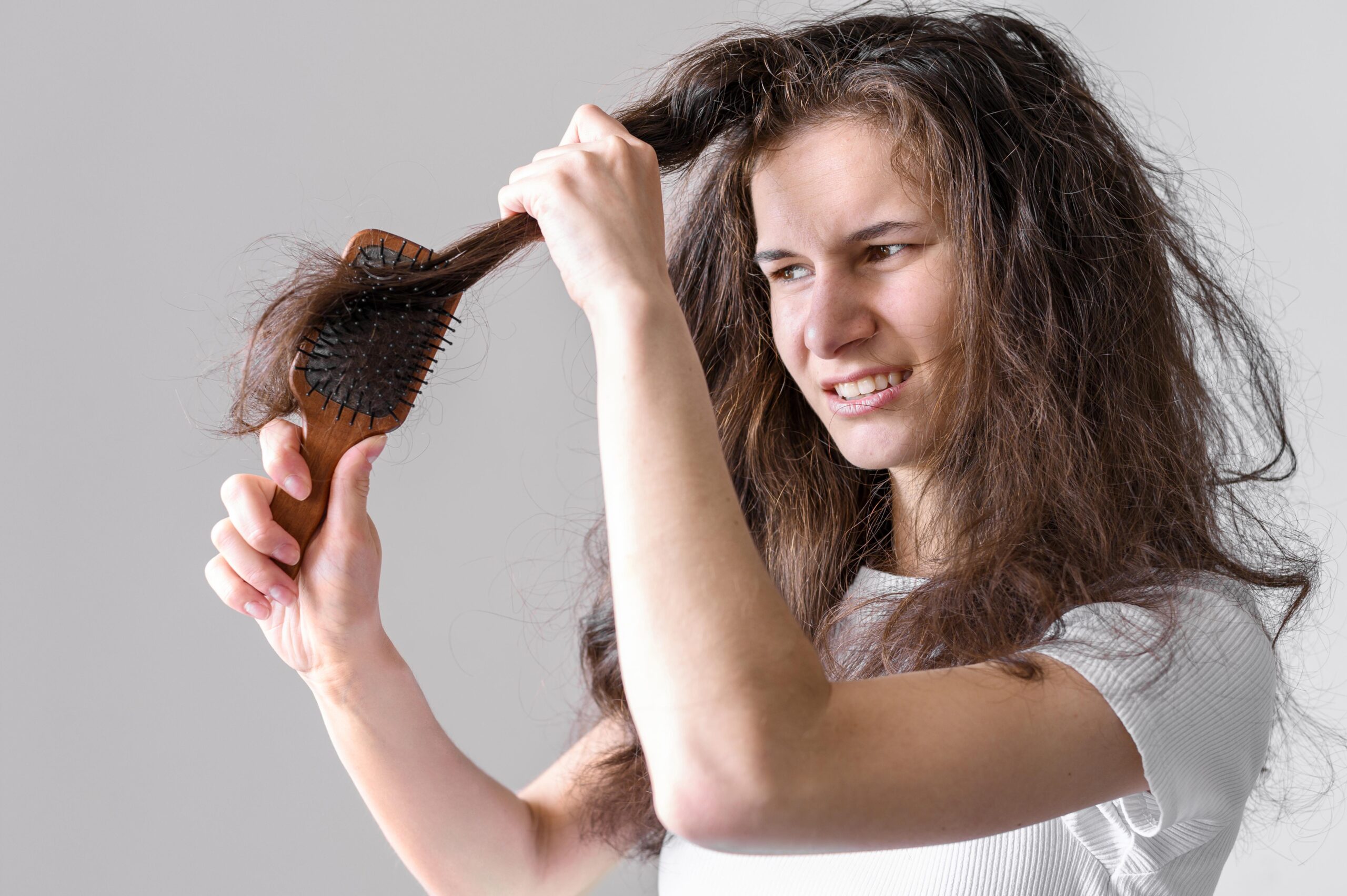
You have tried deep conditioners, hair masks, leave-in treatments, oils, and serums. Your hair feels better in the shower and then, by the next day, it is back to feeling dry, brittle, or dull. Sound familiar?
Here is the thing: persistent hair dryness is almost never caused by using the wrong conditioner. It is caused by something upstream that products alone cannot fix. If you keep adding products without improvement, one of these seven things is probably the real reason.
Your Scalp Is Not Producing Enough Sebum
Most people treat dry hair as a strand problem, but the root cause is often quite literally at the root. Your scalp produces natural sebum — an oil that travels down the hair shaft and acts as its built-in conditioner, coating and protecting each strand in a way no external product fully replicates.
When the scalp is stripped by harsh sulfate shampoos, over-cleansed, or chronically dehydrated, sebum output drops. The hair shaft is then left unprotected from root to tip, and no amount of conditioner applied from the outside truly compensates for that.
What to do:
- Reduce wash frequency if you are currently washing daily or near-daily
- Switch to a gentler, sulfate-free or low-sulfate cleanser
- Use a hydrating scalp serum with hyaluronic acid and panthenol to restore scalp skin health. A healthy, moisturised scalp produces better quality sebum consistently
Hard Water Is Coating Your Hair
If you live in a hard water area, calcium and magnesium deposits build up on the hair shaft over time, forming a mineral film. This film prevents moisture from reaching the hair cortex, so products sit on top of the deposit layer rather than absorbing into the strand.
This is one of the most underdiagnosed causes of persistent dryness. You could be using excellent products and still see poor results simply because they are being applied on top of a mineral barrier. Signs include hair that feels rough and dull even straight after washing, and colour that fades unusually fast.
What to do:
- Use a clarifying or chelating shampoo once every one to two weeks to remove mineral buildup
- Consider a shower head filter if you are in a consistently hard water area. This addresses the problem at the source rather than treating it after the fact
You Are in Protein Overload
Protein treatments strengthen the hair shaft, which sounds like a straightforward win. The problem is that too much protein makes the hair stiff and rigid, which prevents it from absorbing moisture at all. This feels almost identical to dryness, but adding more conditioner will not fix it.
Many people in active repair mode reach for protein-rich products repeatedly, unknowingly creating a cycle where the hair becomes too rigid to hold hydration regardless of what is applied.
A simple test to check: take a wet strand of hair and gently stretch it. If it snaps immediately with no elasticity, protein overload is likely. Healthy hair with good moisture-protein balance will stretch slightly before returning to shape.
What to do:
- Pause all protein-containing products for two to four weeks
- Focus exclusively on moisture-only formulas during this period
- Once the hair regains softness and elasticity, reintroduce protein products at a reduced frequency rather than using them every wash
Silicone Buildup Is Sealing Moisture Out
Many smoothing serums, conditioners, and leave-ins contain dimethicone and similar silicones. These ingredients create an initial feeling of softness and shine, which is genuinely useful short-term. The problem is that without regular clarifying, silicones accumulate on the hair shaft and eventually form a coating that seals moisture out rather than in.
The irony is hard to miss: the products designed to make hair feel better are often the ones creating a long-term moisture barrier problem.
What to do:
- Use a clarifying shampoo every one to two weeks to clear silicone buildup
- When shopping for new products, look for water-soluble silicones such as cyclomethicone or cyclopentasiloxane, which do not accumulate the same way as heavier silicones like dimethicone
Your Application Order Is Working Against You
The sequence in which you apply hair products matters more than most people realise. Two of the most common sequencing mistakes:
- Applying oil before leave-in conditioner. Oil is a sealant. Using it first means the leave-in conditioner cannot penetrate the shaft and is effectively wasted
- Applying treatments to soaking wet hair. Water on the hair dilutes any formula applied to it, significantly reducing efficacy before it has a chance to absorb
The correct order is straightforward once you understand the logic:
| Step | Product | Why |
|---|---|---|
| 1 | Rinse-out conditioner | Deposits moisture into the shaft |
| 2 | Towel dry to damp | Removes excess water so treatments absorb properly |
| 3 | Leave-in conditioner | Locks in moisture while hair is still damp |
| 4 | Oil or hair serum | Seals everything in — always applied last |
Heat Damage Has Broken the Cuticle
The hair cuticle is a protective outer layer of overlapping scales that keeps moisture inside the shaft. Repeated heat styling lifts these scales and, over time, fractures them. Once the cuticle is structurally damaged, the hair cannot retain moisture regardless of what is applied to it because the physical structure that holds moisture in is compromised.
This is a longer-term repair situation rather than a quick fix. No single product reverses cuticle damage overnight.
What to do:
- Reduce heat frequency and use the lowest effective temperature setting
- Incorporate bond-building treatments (formulas containing ingredients like bis-aminopropyl diglycol dimaleate) consistently over several weeks
- Maintain a balanced protein and moisture routine to support gradual cuticle recovery
The Problem Is Internal, Not Topical
This is the one most people do not consider. Iron deficiency directly affects the structural proteins in the hair shaft and reduces scalp sebum quality. It is one of the most common and overlooked causes of persistent dryness, particularly in women. Low omega-3 intake affects the scalp’s natural lipid production, and chronic dehydration reduces the moisture content of the hair shaft from the inside out.
No scalp serum or conditioning mask can address a nutritional deficiency. If persistent dryness is accompanied by increased shedding, thinning, or dullness that does not respond to any topical change, a blood panel checking ferritin and iron levels is worth discussing with a doctor before investing further in products.
Where to Start
If this list feels overwhelming, start with the causes that are free and fast to rule out:
- Check your application order — this alone fixes the problem for a surprising number of people
- Run the protein overload test — stretch a wet strand; if it snaps, you have your answer
- Find out if your area has hard water — a quick postcode check on your water provider’s website will tell you; if it does, a chelating shampoo is a worthwhile experiment
- Look at your scalp health — if your roots get oily fast but your ends stay dry, the scalp-sebum issue is almost certainly involved
Work through these four before adding any new products to your routine. In most cases, one of them is the culprit, and the fix is simpler and cheaper than another serum.
Sources:
- “Study Finds Common Shampoo Surfactants May Strip Natural Oils.” Love Masami, 2026. lovemasami.com/blogs/industry-news/study-finds-common-shampoo-surfactants-may-strip-natural-oils
- “Essentials of Hair Care often Neglected: Hair Cleansing.” PMC NIH, 2010. pmc.ncbi.nlm.nih.gov/articles/PMC3002407/
- “Scanning Electron Microscopy Study of Hair Shaft Changes Related to Hardness of Water.” Indian Journal of Dermatology, Venereology and Leprology, 2013. pmc.ncbi.nlm.nih.gov/articles/PMC3927171/
- “What to Do if You’re in Protein Overload.” Curlsmith Curl Academy, 2026. eu.curlsmith.com/blogs/curl-academy/protein-overload
- “Protein Overload in Hair: Signs, Causes and How to Fix It Fast.” Haste Hair, 2026. hastehair.com/protein-overload-in-hair/
Leave a Reply