
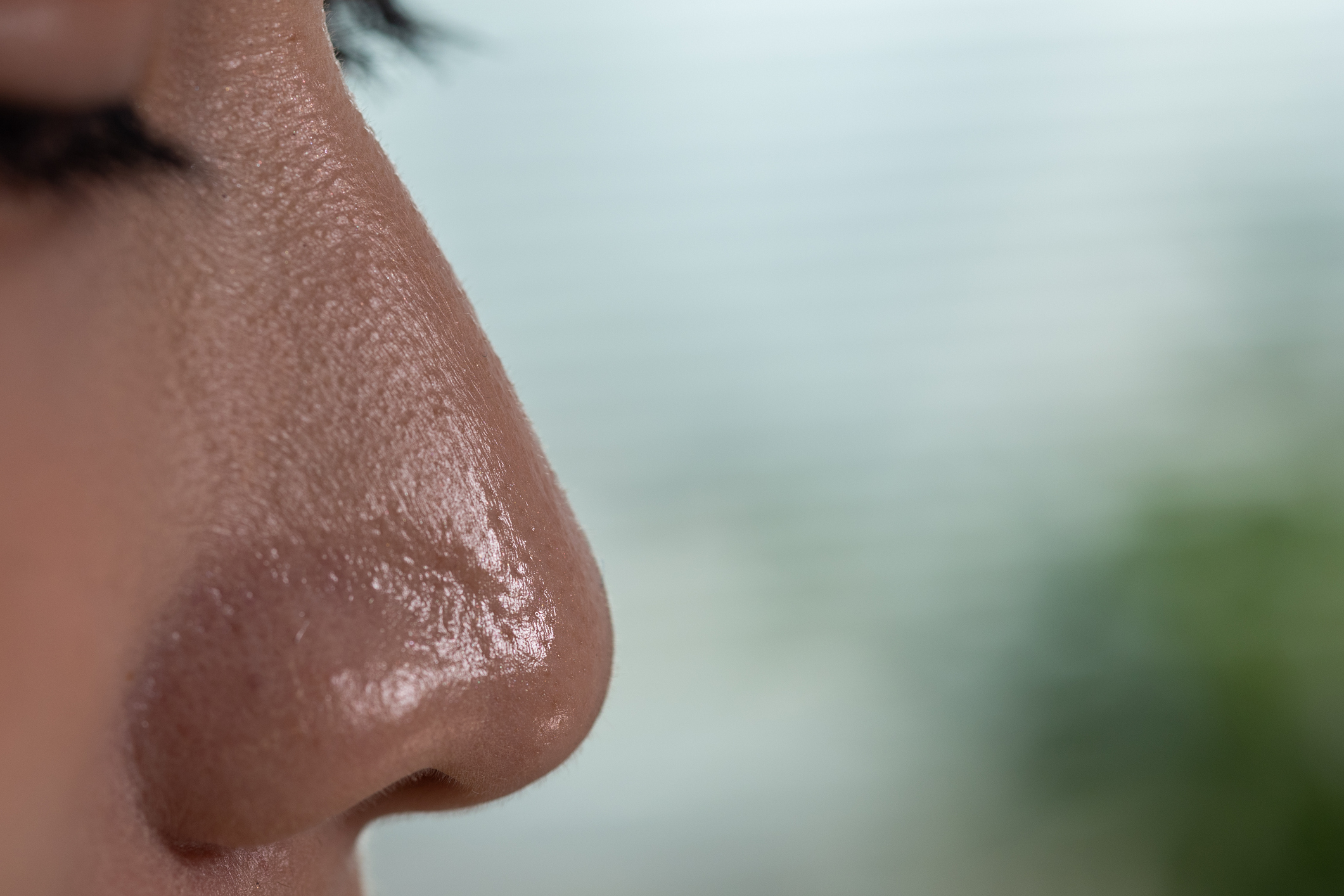
Blot at 11am. Touch up at lunch. Shiny again by 3pm. If this is your daily reality, you already know that the usual advice — use a mattifying primer, carry blotting papers, try a clay mask — does not actually change anything. It manages the surface while the same cycle continues underneath.
The reason most oily skin fixes do not stick is that they address the oil after it has already appeared, rather than the biological process producing it. Sebum is manufactured inside the sebaceous gland, regulated by hormones, barrier signals, and inflammatory triggers, and secreted onto the skin surface through the follicle. Anything applied on top of that is working downstream. Real regulation has to happen closer to the source.
This post covers what actually drives excess oil production, the ingredients and devices with clinical evidence for reducing it, and why some of the most popular oily skin products are making the problem worse.
Why Skin Overproduces Oil in the First Place
Sebaceous glands produce sebum in response to three main signals: hormonal activity, barrier damage, and inflammation. Identifying which is your primary driver matters because the solutions differ.
- A stripped or damaged skin barrier is the most common and most fixable cause of persistent oiliness. When harsh cleansers, over-exfoliation, or alcohol-based products strip surface oil, the skin interprets this as a barrier threat and compensates by increasing sebum production. If your skin feels oily in the T-zone but tight or flaky around the cheeks, a disrupted barrier is almost certainly involved, and adding more oil-control products will accelerate the cycle rather than break it.
- Hormonal sebum overproduction is driven by androgens, which directly stimulate sebaceous gland activity. Cortisol released during stress elevates androgen activity, which is why skin often gets oilier during high-stress periods. For women, oiliness that tracks with the menstrual cycle is a clear hormonal signal.
- Genetic sebaceous gland density simply means some people have more glands per square centimetre of skin than others. This cannot be changed, but it can be regulated significantly with the right combination of ingredients and devices over time
Additionally, excess oil production is often the root cause of enlarged pores (read more on how to minimize pores here).
The Ingredients With Real Evidence for Sebum Regulation
| Ingredient | How it works | Best for |
|---|---|---|
| Niacinamide (2–5%) | Reduces sebum excretion rate; calms inflammation; shrinks pore appearance | All oily skin types |
| Salicylic acid (BHA, 0.5–2%) | Oil-soluble; penetrates follicle to dissolve sebum and debris buildup | Congested, acne-prone oily skin |
| Zinc (zinc PCA / zinc gluconate) | Inhibits 5-alpha reductase, reducing DHT-driven sebaceous gland stimulation | Hormonally driven oiliness |
| Retinoids | Bind to sebaceous gland receptors; reduce gland size and output over 8–12 weeks | Long-term sebum regulation |
| Lightweight ceramide moisturiser | Repairs barrier signal; reduces compensatory sebum overproduction | Oily skin with barrier damage |
A few notes on usage:
- Niacinamide shows measurable sebum reduction after four weeks of consistent use and is well tolerated by most skin types
- Salicylic acid is most effective at two to three applications per week. Daily use tips into barrier stripping territory and worsens rebound oiliness
- Retinoids require gradual introduction. Starting too fast temporarily worsens oiliness as the barrier adjusts before improving
- Ceramide moisturiser is the most counter-intuitive recommendation here and the most important one to follow. Moisturising a stripped barrier reduces the compensatory sebum signal driving overproduction. Gel or water-based ceramide formulas provide barrier support without occlusive weight.
What Feels Like It Is Working (But Is Not)
These are the most common oily skin products, habits, and why they do not address the underlying problem:
- Mattifying primers and setting powders absorb surface oil for a few hours but do not interact with sebaceous gland activity in any way. The oil returns at the same rate because production has not changed
- Alcohol-based toners strip surface oil immediately, which creates the illusion of control. The skin’s barrier response to stripping is to increase sebum production — within hours the skin is oilier than before the toner was applied. Despite this, alcohol-based toners remain among the most widely marketed products for oily skin
- Daily clay masks are effective for deep follicle cleansing once a week. Used daily, they strip the barrier and trigger the same rebound effect. The satisfying tightness after a clay mask is the sensation of barrier disruption, not the sensation of oil being controlled
- Aggressive foaming cleansers present the same problem. The squeaky-clean feeling signals that the skin’s natural lipid layer has been removed, which is the fastest route into the overproduction cycle
At-Home Devices That Reduce Sebum Production

| Device | Mechanism | Evidence level | Home availability |
|---|---|---|---|
| Blue LED (415 nm) | Reduces sebaceous gland inflammation; suppresses acne-causing bacteria | Moderate — anti-inflammatory pathway | Yes — widely available |
| 1450nm NAFL (Non-Ablative Fractional Laser) | Thermal energy targets sebaceous glands directly; reduces gland count and output | Strong — published clinical data | Yes — consumer devices available |
| Fractional RF microneedling | RF energy disrupts and reduces sebaceous gland size and density | Strong at clinical energy; moderate at home energy | Partially — some home versions |
| Galvanic (deep cleanse mode) | Ionic current draws sebum and debris out of follicle | Supportive — best as a prep step | Yes |
More detail on the two strongest options:
- 1450nm NAFL: a published clinical study found an 8.5% reduction in sebum-producing follicles at week four, rising to 16.7% at week six, with an 18% reduction in total sebum collected. Home devices operate at lower energy but deliver meaningful sebum suppression with consistent use. The same device is also covered in our hyperpigmentation guide for its pigmentation benefits — a dual-purpose tool worth knowing about.
- Fractional RF microneedling: a prospective clinical study found a 30 to 60% reduction in casual sebum levels and 70 to 80% reduction in sebum excretion rate after a single clinical treatment. Histological analysis confirmed decreased sebaceous gland size and density. Home versions produce more modest results but the mechanism is the same.
Building the Right Routine
Morning:
- Gentle low-foam or gel cleanser: no sulfates, no alcohol
- Niacinamide serum (2–5%)
- Lightweight ceramide moisturiser
- Mineral SPF with zinc oxide: doubles as a mild sebum regulator and is non-comedogenic
Evening:
- Oil cleanser to remove SPF and makeup, followed by gentle second cleanser
- Salicylic acid treatment on two to three evenings per week
- Retinoid on non-salicylic evenings: start at the lowest available strength and build gradually
- Lightweight ceramide moisturiser
Weekly:
- Clay mask once per week for deeper follicle cleansing
- Blue LED or NAFL sessions three to four times per week alongside the routine
What to Realistically Expect
| Treatment | Visible improvement timeline |
|---|---|
| Niacinamide | Measurable sebum reduction within 4 weeks |
| Salicylic acid | Reduced congestion and shine within 2–4 weeks |
| Retinoids | Meaningful gland-level regulation at 8–12 weeks |
| Blue LED | Cumulative improvement over 4–8 weeks of regular sessions |
| NAFL device | Sebum reduction builds over several weeks of consistent use |
One important note: if oiliness is significantly cyclical — clearly worse at certain points in the menstrual cycle or during high-stress periods — topical management will help but only up to a point. Hormonal oiliness at a clinical level is better addressed in conversation with a professional than through skincare alone.
The Goal Is Not Oil-Free Skin
Sebum is not the enemy. It lubricates the skin, supports the barrier, and protects against environmental damage. The goal is regulated, balanced production, not elimination. Skin that has been stripped into apparent oil control is not healthy skin; it is a barrier in compensatory overdrive.
The ingredients and devices above work with sebaceous gland biology rather than against it, which is why their results last beyond the next blotting session.
Sources:
- “Oily Skin: A review of Treatment Options.” PMC NIH, 2017. pmc.ncbi.nlm.nih.gov/articles/PMC5605215/
- “The 1450-nm diode laser reduces sebum production in acne-prone skin.” Dermatologic Surgery, 2006. pubmed.ncbi.nlm.nih.gov/17311272/
- “Assessment of treatment efficacy and sebosuppressive effect of fractional radiofrequency microneedle on acne vulgaris.” Lasers in Surgery and Medicine, 2013. onlinelibrary.wiley.com/doi/abs/10.1002/lsm.22200
- “A novel technique in reducing sebum production and improving atrophic acne scars with fractional microneedling radiofrequency.” Journal of Cosmetic Dermatology, 2022. onlinelibrary.wiley.com/doi/full/10.1111/jocd.15137
- “Home-based devices in dermatology: a systematic review of safety and efficacy.” PMC NIH, 2021. pmc.ncbi.nlm.nih.gov/articles/PMC8918178/
Leave a Reply